Dating App Research
About
Challenges
My Role
Outcome
The Value
User Interviews
We conducted in-person interviews with several active dating app users to better understand their habits, preferences, and frustrations with existing platforms. Our goal was to uncover not only how users engage with dating apps, but also what underlying needs and desires remain unmet in the current market. We asked questions about dating habits, specific feature preferences, and their overall experiences navigating the online dating landscape. This qualitative research gave us valuable insight into how people perceive and use these tools in real life, and what opportunities might exist for a differentiated solution.
Our Findings
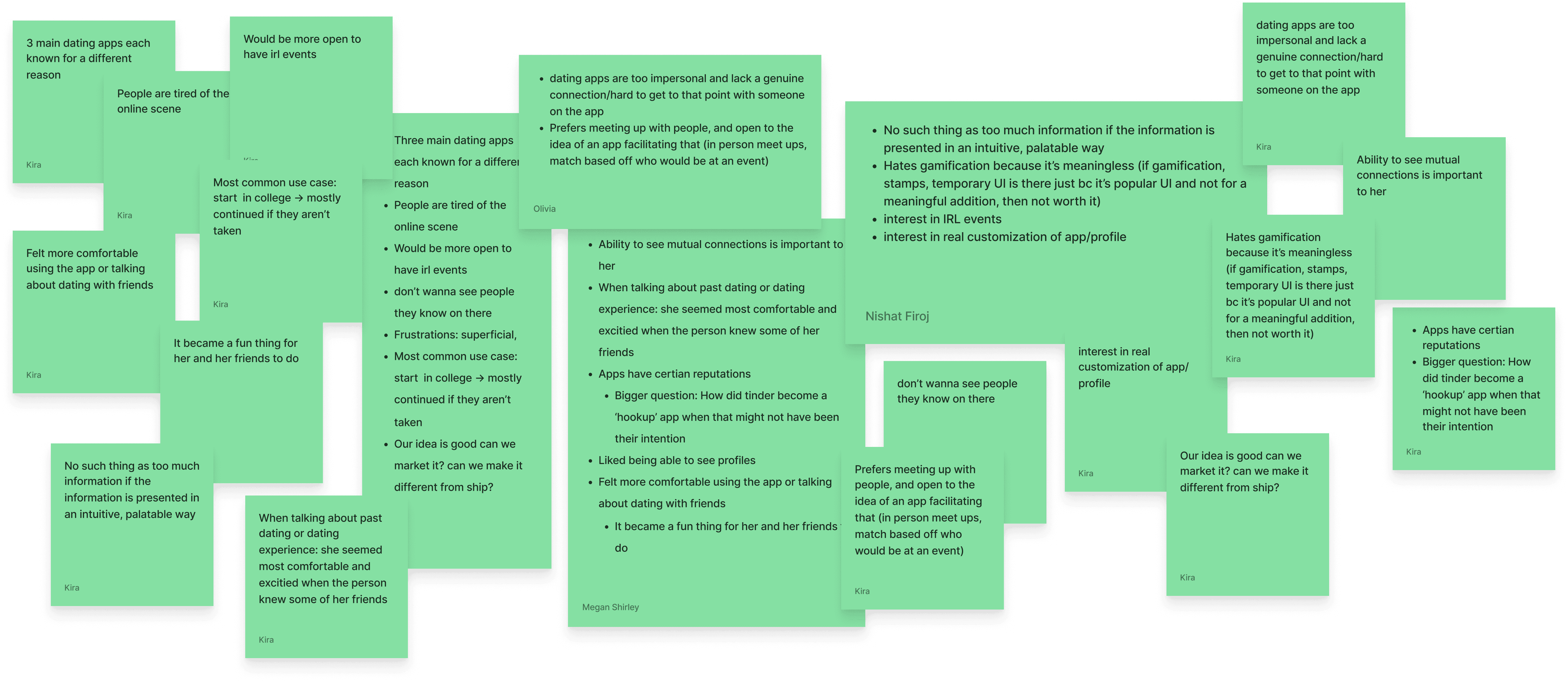
Through our interviews, several consistent themes and insights emerged:
Fatigue with the online dating scene - Many participants expressed frustration with the repetitiveness and superficial nature of dating apps. They felt the process often lacked authenticity and emotional connection.
Strong interest in in-person experiences - Users were open to the idea of apps facilitating real-life meetups or events, signaling a desire for dating products that extend beyond digital interactions.
Concerns around familiarity and privacy - A common hesitation was not wanting to encounter people they already knew on apps, highlighting the delicate balance between social connection and privacy.
Social comfort through mutual connections - Users felt more comfortable and excited when potential matches had mutual friends or social overlap, suggesting that context and trust-building are critical factors in adoption.
App reputations and stereotypes - Each major dating app carried its own “brand” (e.g., hookup culture, casual dating, long-term relationships), which influenced user behavior and expectations. Some users even questioned how apps like Tinder evolved away from their original intentions.
Mixed feelings about gamification - Many users disliked “gamified” features, such as badges or temporary UI elements, perceiving them as shallow or meaningless unless they added true value to the experience.
Customization and control matter - Users wanted greater ability to personalize their profiles and experiences, seeing customization as a way to present themselves authentically and feel more ownership over their app presence.
Dating as a social activity - For some, app use became fun when done collectively with friends — either sharing experiences or using the app together — reinforcing that dating apps are not only individual tools but also social ones.
Competitive Analysis
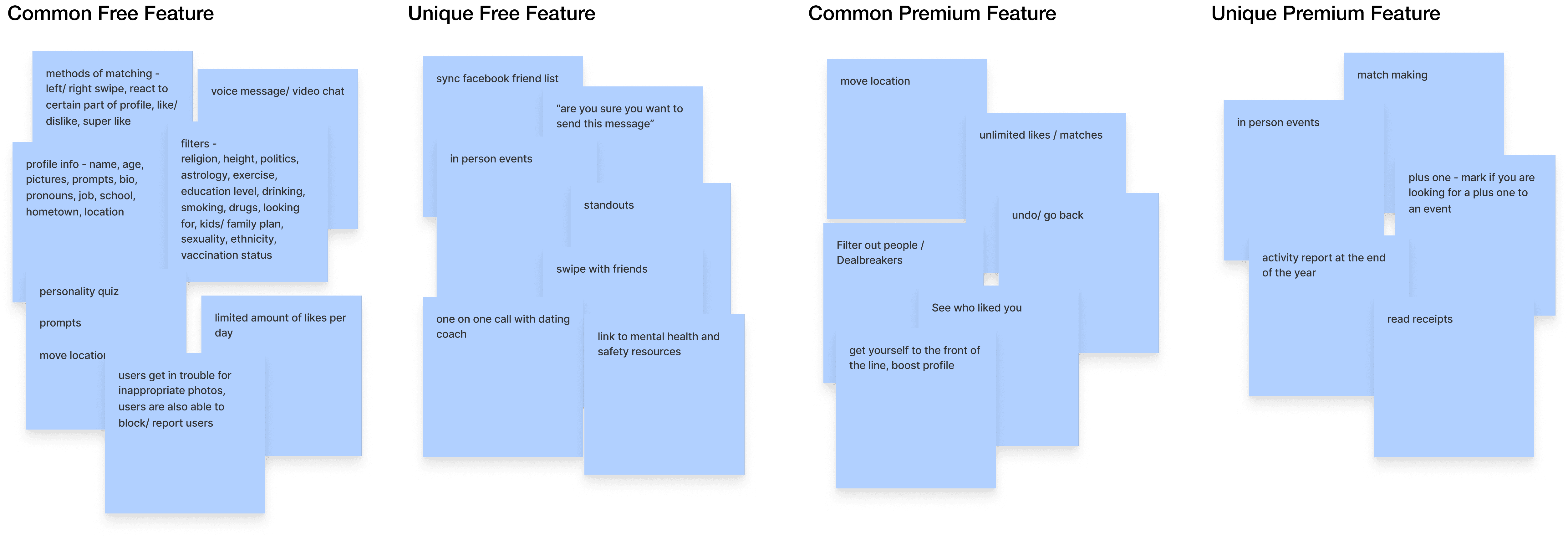
To better understand the dating app landscape, we conducted a competitive analysis of leading platforms including Hinge, Match, Tinder, and Bumble, as well as several niche apps. This process allowed us to identify patterns in both free and paid feature offerings—highlighting which features were considered standard across most apps, which were differentiators, and where opportunities for innovation might exist. Competitive analysis is especially critical in crowded markets like online dating, where user expectations are shaped by dominant players. By evaluating the strengths, weaknesses, and unique value propositions of existing apps, we were able to determine not only the “must-have” features for parity, but also potential white space where our product could stand out. This foundation ensured that our concept was informed by both industry norms and unmet user needs.
Feature Mapping
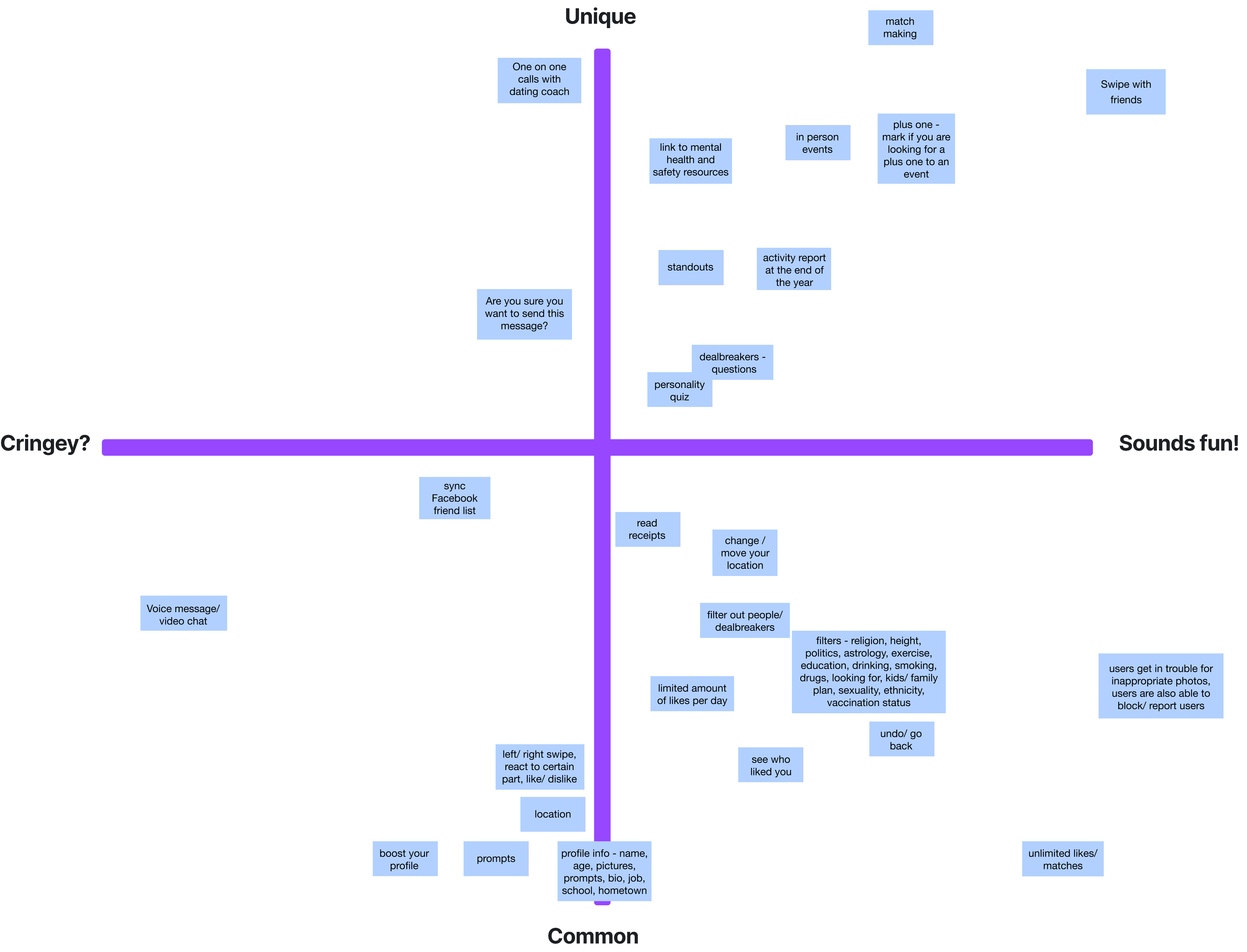
To synthesize our findings, we plotted features onto a two-axis chart to visualize their positioning within the market. The horizontal axis ranged from cringey to fun, reflecting how users might emotionally respond to a feature, while the vertical axis represented a spectrum from common to unique. By placing each feature along these dimensions, we created a visual map that highlighted clusters of overused features as well as gaps that revealed potential opportunities. This exercise gave us a clearer perspective on which features were table stakes, which ones risked being off-putting, and where we could differentiate by offering playful, innovative features that competitors had overlooked. Ultimately, the mapping process helped us prioritize features strategically, balancing user expectations with opportunities for delight and differentiation.
Survey
To complement our interviews and competitive analysis, we launched a survey to capture a wider, more quantitative perspective on people’s dating behaviors and attitudes. The goal was to validate our qualitative findings at scale and uncover patterns across a broader audience.
We asked participants about their relationship status, goals for using dating apps, experiences with subscriptions, and openness to new features. Responses came primarily from young adults (ages 18–30), which aligns with the target demographic for most dating platforms.

Survey Results
The survey data provided several key insights:
Demographics & Relationship Status
The majority of respondents were 18–30 years old, with the largest group being 18–25 (44.5%)
Relationship statuses skewed toward single and looking (44.5%) and in a relationship (21.8%), with fewer married users (4.5%).
This shows the app’s core target audience is young, single adults actively seeking relationships.
Attitudes Toward Online Dating
Around 43.6% agreed/strongly agreed that online dating is an effective way to form relationships, while 31.8% remained neutral.
This suggests there is general openness but lingering skepticism about online dating’s effectiveness
Usage & Subscriptions
A strong majority have used dating apps: 44.5% currently, 39.1% previously, and only 16.4% never.
Most users do not pay for premium features (59.5%), but over 40% have paid at some point, indicating there’s willingness to pay under the right value proposition.
Goals & Outcomes
The top goal for using dating apps was seeking a relationship (56.5%), followed by dates (18.5%) and meeting new people (13%).
Over half (53.3%) had developed a relationship from a dating app, reinforcing that meaningful connections are possible and desired.
Feature Exploration
Respondents showed moderate to high interest in innovative features such as:
Double date feature: Interest was distributed, but many leaned positively (especially toward lower/mid ratings).
Friend-matching feature: Responses skewed more positively, with higher interest at the 4–5 scale points.
These results suggest users are open to socially-driven or community-based enhancements to traditional dating experiences.
Takeaways
The survey highlighted a few opportunities for innovation:
Design for relationship-seekers first: While casual dating exists, the majority of users are motivated by finding meaningful connections.
Build trust and credibility: Neutral perceptions of online dating suggest space for features that feel safer, more authentic, and community-driven.
Experiment with social layers: Features like friend-matching and group dates resonate with users, pointing to an opportunity to make dating feel less isolating and more social.
Rethink monetization: Since many users have paid before, but most don’t pay consistently, premium features should offer clear, tangible value tied to trust or social engagement.
Ideation
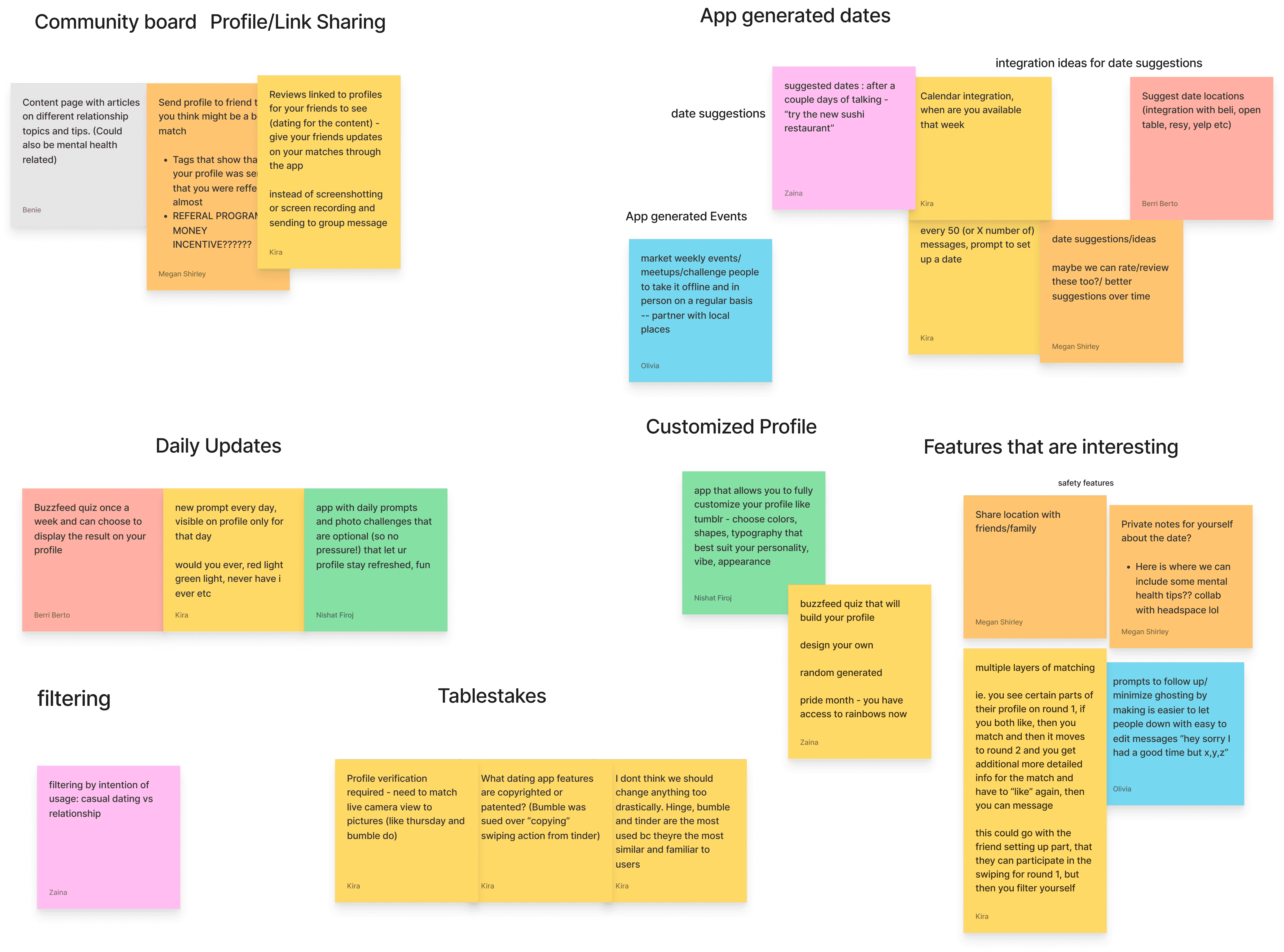
After synthesizing our research insights, we moved into ideation. Each team member contributed sticky notes with feature ideas, ranging from table-stakes functionality to more innovative or playful concepts.
We focused on:
Favorite ideas that excited us personally.
Essential features that every dating app would need to feel viable.
“Nice-to-have” ideas that could differentiate our concept in the market.
Once we had a large pool of ideas, we grouped them into themes such as profile customization, app-generated dates, safety features, daily prompts, and community-driven elements. This clustering helped us see patterns in our thinking and align on what felt most promising.
Our Conclusion
We came out of this process energized by several of our concepts — such as friend-involved matching, double-date integrations, and customizable profiles. However, we also had to confront the practical challenges:
Building trust and credibility in online dating is incredibly hard.
A dating app’s value depends heavily on achieving a critical mass of users, which is difficult in an oversaturated market.
Competing with both major players (Tinder, Bumble, Hinge) and niche apps requires not only innovative features but also substantial resources.
